

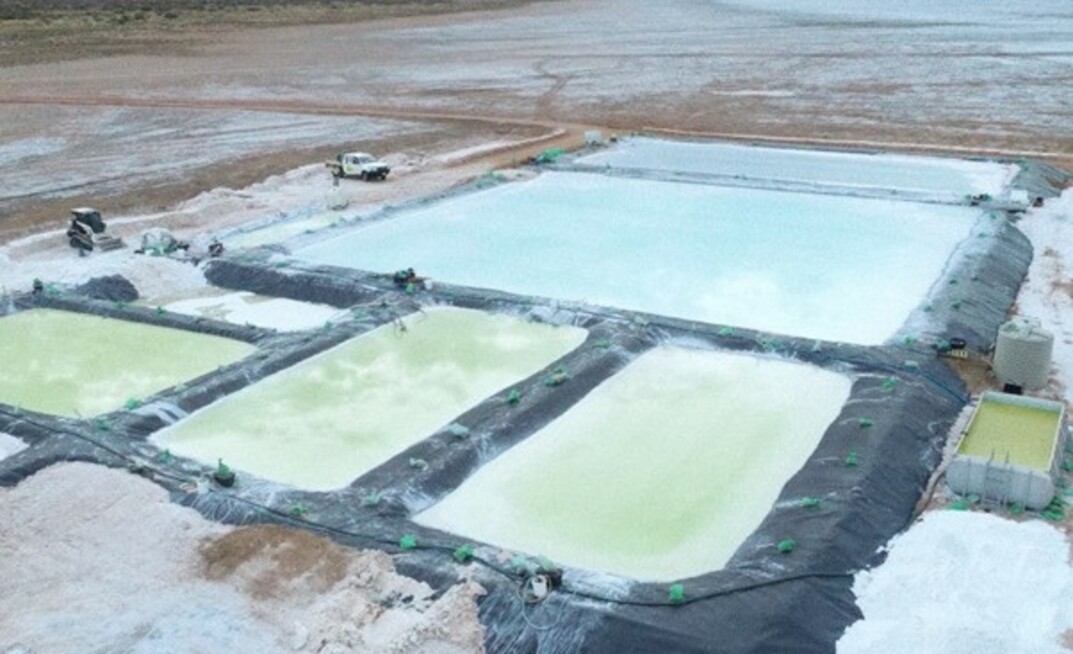


Ongoing process test work at the Mackay potash project in Western Australia's Great Sandy Desert has determined the optimal temperature to manage startup feed salt composition.
Testwork has also given Agrimin better insight into the mineralogy of startup feed salts that are unique to WA sulphate of potash projects.
As part of a technical review into the project with Veolia Water Technologies, Agrimin found a mineralisation anomaly in the harvested salts during startup where leonite occurred with schoenite.
Further investigations established the presence of leonite in the precipitated harvest salts was exclusive to WA salt lake projects and happened due to climatic conditions.
YOU MIGHT ALSO LIKE
They found formation of Leonite was exacerbated during startup until brine recirculation developed higher magnesium levels in the ponds and plant.
Further testing resulted in sub-optimal recovery rates of about 60% as leonite does not readily float like schoenite does.
They subsequently worked out how to convert leonite to schoenite through temperature control and sufficient residence time in a cooling crystalliser.
The optimal temperature required in the conversion stage is about 15C.
Mackay will become the first SoP development in WA to use a cooling crystalliser for temperature-controlled feed salt conversion.
Agrimin process manager Graeme Ditri said discovering the occurrence of leonite in the feed salts had a profound impact on their understanding of the required process flowsheet.
"While Schoenite and Leonite are very similar, the difference in waters of hydration affects how the salts respond in flotation," he said.
"By understanding industry learnings and working in collaboration with Veolia, the test plan we created has tested a range of scenarios and sensitivities to narrow down the key design parameters required in conversion, the first stage of the process."
Ditri said using a cooling crystalliser for conversion enabled tight and uniform temperature control for the required conversion ahead of flotation, the second stage of the process.
"We look forward to our continued partnership with Veolia and commencing flotation test work with FLSmidth," he said.
Agrimin chief executive officer Debbie Morrow said conversion to schoenite ahead of flotation, being the second stage in our process flow sheet was essential and they now had a thorough understanding of the required cooling crystalliser conditions to resolve the occurrence of leonite.
"This development validates our patient and diligent approach to delivering the Mackay potash project and we look forward to continued collaboration and testing with Veolia and FLSmidth to finalise our process design and progress equipment selection," she said.



















